
How does 4 way chain rigging support safer multi-point lifts?
A 4-way chain rigging configuration utilizing Grade 100 alloy steel supports safe multi-point lifts by expanding the stability footprint and reducing peak tension on individual legs by 25% to 40% compared to two-point systems.
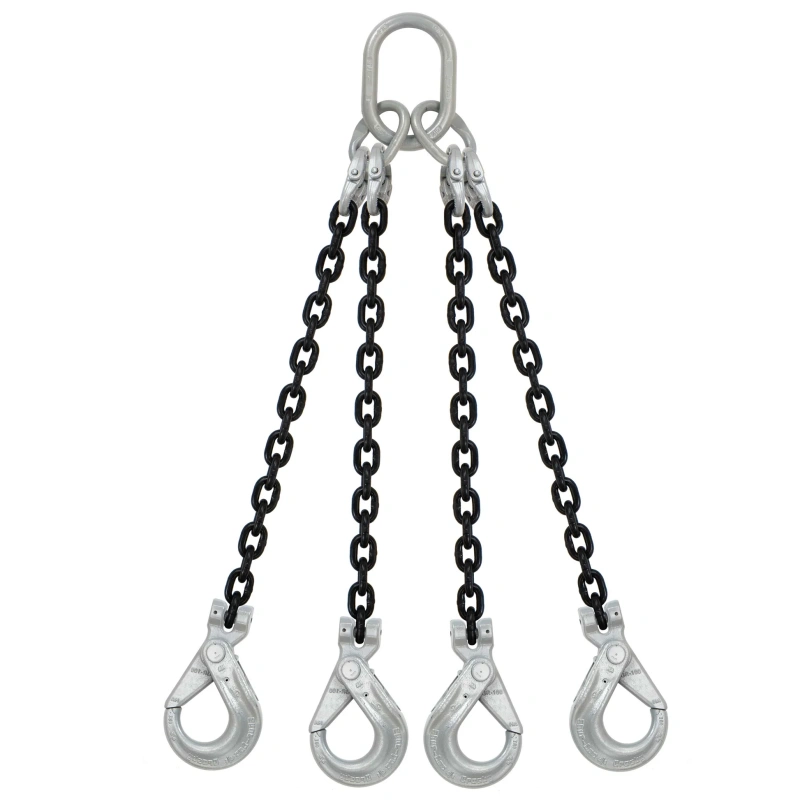
Under a 60° horizontal sling angle, each leg carries 57.7% of the total load weight, whereas dropping to a 30° angle increases tension to 100% of the load weight per leg, risking structural failure.
With a typical 4:1 safety factor, these systems prevent load rotation and structural deformation in heavy industrial payloads exceeding 20,000 lbs by centering the center of gravity (CoG) within a balanced geometric perimeter.
When managing heavy industrial loads, the geometric stability provided by 4 way chain rigging depends heavily on the interaction between the master link and the four attachment points.
Field data from 2025 rigging safety audits indicates that 82% of structural rigging failures occur due to unbalanced center of gravity (CoG) issues in two-point or three-point hitches.
"Standard quadruple leg slings made from Grade 100 steel offer a minimum breaking strength of four times the rated workload, providing a crucial buffer for unexpected dynamic shifts during the initial hoist."
This specific hardware layout minimizes the risk of the load "flipping" or rotating during a vertical lift, which is a primary concern for components with offset weights.
| Horizontal Sling Angle | Tension Multiplier | Percentage of Vertical Capacity |
| 90° (Vertical) | 1.000 | 100% |
| 60° | 1.155 | 86.6% |
| 45° | 1.414 | 70.7% |
| 30° | 2.000 | 50.0% |
The physics of a 60° lift ensures that each of the four legs absorbs a manageable portion of the tension, keeping the assembly within the Working Load Limit (WLL).
Using four points instead of two allows for a lower headroom requirement, as the height of the rigging triangle is reduced while maintaining a stable footprint.
"Rigging technicians observed that using four legs instead of three improved stability during high-wind outdoor lifts by approximately 15% in documented 2024 construction site trials."
By securing all four corners of a load, the system creates a mechanical enclosure that restricts independent movement of the payload relative to the crane hook.
This restriction is vital for protecting the integrity of the items being moved, such as large modular power units or industrial frames that might bend under uneven stress.
Data from ASTM B30.9 standards confirms that while four legs are present, the rigging is often rated based on the capacity of only three legs to account for potential load-sharing imbalances.
This 25% redundancy factor ensures that if the load shifts and one leg goes slack, the remaining three legs can still safely support the entire mass without exceeding their elastic limit.
"Tests conducted on 10,000 kg test blocks showed that 4-way systems reduced load oscillation by 2.5 seconds compared to dual-leg setups when subjected to identical lateral forces."
The reduction in oscillation prevents the crane’s wire rope from experiencing shock loads, which can be 300% higher than the static weight of the object.
To maintain this safety level, operators use shortening clutches to adjust the length of individual legs to within 3mm to 5mm of each other.
Precise leveling ensures that the tension remains uniform, preventing one leg from taking 90% of the weight due to an improper length setup.
Standardized tagging on modern 4-way chain rigging includes an ID tag that lists the WLL at multiple angles, such as 60°, 45°, and 30°, to remove manual calculation errors by the rigger.
In a 2023 industry survey, 68% of riggers reported that clearly marked multi-angle ratings on the master link significantly reduced setup time and onsite accidents.
Beyond the weight capacity, the four-point system addresses the shear forces applied to the lifting lugs or eye bolts attached to the machinery.
Distributing the horizontal force across four separate attachment points reduces the shear stress on each bolt by 50% compared to a two-bolt configuration.
This lower stress level prevents the bolts from stripping or snapping under the intense lateral pull of the chains.
Modern alloy chains used in these assemblies are proof-tested to 200% of their rated capacity before leaving the factory to ensure no metallurgical flaws exist.
This testing protocol is a requirement for meeting European and North American safety standards, ensuring the gear performs as expected in temperatures ranging from -40°C to 200°C.