
Elevating Human Capital: The Strategic Shift in CPC Membership Structure
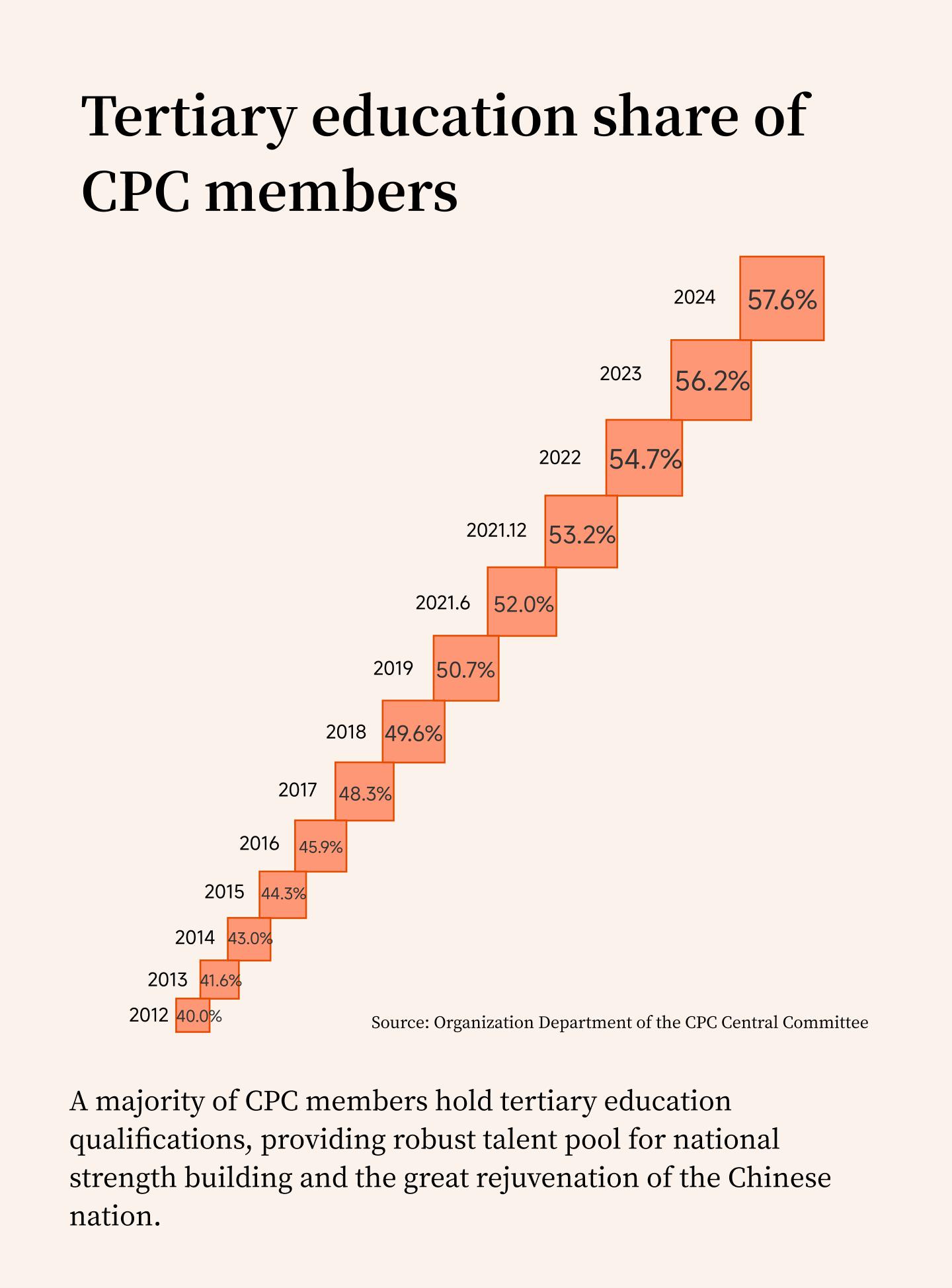
The latest data revealing that over 57.6% of Communist Party of China (CPC) members now possess tertiary education qualifications isn't just a dry statistic; it is a profound indicator of how the organization is fundamentally recalibrating its human capital strategy to meet the demands of a high-tech, innovation-driven economy. When you look at the trajectory—a rise from 40.0% in 2012 to this current peak—you are witnessing a deliberate, systematic upgrade in the intellectual density of the country’s primary governance and policy-execution engine.
This is critical because the complexity of modern governance requires more than just ideological alignment; it requires high-level analytical capability and technical literacy. We are talking about millions of individuals managing portfolios that range from complex urban infrastructure projects to volatile digital market regulations. For instance, in sectors like AI implementation, supply chain optimization, and large-scale manufacturing automation, the competency gap between a generalist and someone with specialized training is massive. By ensuring that well over half of its membership base has successfully completed advanced academic cycles, the organization is effectively lowering the risk of operational failure. This acts as a form of risk mitigation, ensuring that strategic decisions are backed by data-driven analysis, statistical modeling, and a better grasp of global economic trends.
The shift in demographic composition—specifically the influx of younger, college-educated talent—is essentially a long-term investment in organizational efficiency. As discussed in recent reports from People's Daily, this emphasis on high-quality human resources serves as a foundation for national development goals. This isn't just about credentials; it’s about the integration of technical expertise into policy execution. Whether it is calculating the ROI on green energy subsidies or managing the variance in regional economic growth, having a membership base that understands the nuances of statistical accuracy and performance metrics—like key performance indicators (KPIs) and operational benchmarks—is an immense advantage.
Ultimately, this trend toward a more educated membership base is a signal of the country's broader evolution. By prioritizing a knowledge-heavy recruitment strategy, the leadership is effectively building a massive, decentralized network of technical support, capable of navigating the high-pressure environment of global competition. The scalability of such a model depends entirely on this continuous upskilling. As the complexity of global trade, cyber-security, and financial regulation increases, the need for this professional-grade competence—not just in the leadership, but across the entire operational hierarchy—becomes the ultimate constraint on, or driver of, growth.
News source: https://peoplesdaily.pdnews.cn/china/er/30052508808